2026 HIPAA Updates: What Security Leaders Need to Know + Compliance Checklist
After years of static regulation, HIPAA is finally evolving. As of May 2026, the Department of Health and Human Services (HHS) has moved to finalize the most significant updates to the HIPAA Security Rule in over a decade. These changes, coupled with the February 2026 Privacy Rule mandates, shift the burden from "addressable" suggestions to mandatory operational requirements.
This marks a turning point for CISOs, CIOs, and security leaders who must now balance innovation with accountability. It’s a shift in how compliance, risk, and technology intersect.
Here is the breakdown of the key changes, their impact on your security strategy, and a ready-to-use HIPAA Compliance Matrix built to help CISOs turn regulatory mandates into measurable progress.
What’s Changing? The 2026 Regulatory Reality
The new HIPAA landscape is defined by three major pillars that every Healthcare CISO must address:
Mandatory Technical Safeguards: The distinction between "required" and "addressable" implementation specifications is gone. Measures like Multi-Factor Authentication (MFA) and Encryption of ePHI (at rest and in transit) are now strictly mandatory.
Dynamic Asset Inventory: Organizations must now maintain a real-time, up-to-date technology asset inventory and network map. If you don’t know where your ePHI is flowing—including through AI tools—you are non-compliant.
Accelerated Incident Response: The window for reporting is shrinking. Proposed rules push for 24-hour notification for certain security incidents and require contingency plans that can restore systems within 72 hours of a loss.
HIPAA Compliance Matrix
Compact, actionable matrix mapping proposed and recent HIPAA changes to cloud and cybersecurity controls. Use this as a checklist you can assign to technical owners.
How to use this matrix:
1. Copy this document into your compliance tracker or ticketing system.
2. For each row, fill the Current State Checklist column with Yes/No/Partial and assign owners in the Action Items column.
3. Use the Priority column to plan sprints: start with High-priority technical controls (MFA, encryption, inventory, logging, vendor BAAs) and follow with process items (training, documentation).
| Requirement / Topic | Source & Status | What it Requires | Impact on Cloud / Cybersecurity | Current State | Action Items (Owner) | Priority | Effort |
|---|---|---|---|---|---|---|---|
| Multi-Factor Authentication (MFA) | HIPAA Security Rule (NPRM proposed) | MFA for all remote & privileged access to ePHI; stronger auth controls | Identity & access mgmt updates; may require SSO, conditional access, enforce MFA on cloud services | Implement SSO + conditional access; roll out MFA for all accounts with ePHI access; exceptions policy | High | Medium | |
| Encryption: At Rest & In Transit | Security Rule (NPRM) + best practice | Encryption that meets defined standards for ePHI in storage and transit; key lifecycle mgmt | Ensure cloud storage, DBs, backups, and API traffic are encrypted; KMS management & key rotation | Inventory all ePHI stores; enable provider-managed encryption or BYOK; document key rotation policy | High | Medium-High | |
| Network Segmentation & Least Privilege | Security Rule (NPRM) | Logical separation of ePHI systems from non-ePHI; enforce least privilege access | VPC/subnet design, ACLs, security groups, Zero Trust microsegmentation in cloud | Map ePHI flows; create segmented VPCs, NGFW policies; enforce IAM roles with least privilege | High | High | |
| Formal Risk Assessment & Continuous Risk Mgmt | Security Rule (NPRM) + OCR guidance | Documented, periodic risk analysis; continuous monitoring for threats/vulns | Integrate cloud asset inventory with risk tools; continuous scanning (CSPM, vulnerability mgmt) | Run gap analysis vs NPRM requirements; deploy CSPM/CMDB; schedule quarterly risk reviews | High | Medium-High | |
| Inventory of Systems, Apps & Data (ePHI Inventory) | Security Rule (NPRM) | Maintain an authoritative inventory of systems, apps, endpoints that store or transmit ePHI | Use cloud tagging, CMDB, automated discovery to keep inventory current | Tag all resources handling ePHI; deploy discovery scripts and CMDB sync; validate quarterly | High | Medium | |
| Business Associate Agreements (BAAs) & Vendor Oversight | Security Rule (NPRM) + Privacy updates | BAAs required; stronger vendor oversight, audit rights, security obligations | Review cloud vendors (IaaS, PaaS, SaaS) for BAAs; include incident notif SLAs and audit capabilities | Catalog vendors, obtain/renew BAAs, perform vendor risk assessments, include security SLA terms | High | Medium | |
| Logging, Monitoring & Audit Trails | Security Rule (NPRM) | Detailed logging of access to ePHI; immutable audit trails; retention policies | Enable cloud provider audit logs, SIEM forwarding, detection rules for anomalous access | Centralize logs to SIEM/SOC; implement alerts for sensitive PHI access; define retention (per policy) | High | Medium | |
| Incident Response & Breach Notification | Security Rule (NPRM) & HIPAA Breach Rule | Documented IR plan with breach identification, containment, notification timelines | Playbooks for cloud incidents, forensics capability (preserve logs, snapshots), BA notification flows | Update IR plan for cloud, run tabletop exercises, define notification roles and timelines | High | Medium | |
| Access Controls: RBAC, PAM & Just-In-Time | Security Rule (NPRM) | Strong access controls, role-based access, privileged access management | Integrate PAM for privileged cloud/admin accounts; JIT elevation for emergencies | Implement RBAC in cloud IAM, deploy PAM/JIT for admins, review access quarterly | High | Medium-High | |
| Data Loss Prevention (DLP) & Exfiltration Controls | Security Rule (NPRM) | Controls to prevent unauthorized ePHI exfiltration (DLP, egress controls) | DLP for cloud storage and endpoints, egress filtering, CASB for SaaS apps | Deploy DLP/CASB, set policies for ePHI classification and blocking; test exfil scenarios | High | High | |
| Encryption Key Management (BYOK vs Provider) | Security Rule (NPRM) | Documented key custodian duties, rotation, access controls, split custody if required | Evaluate provider KMS vs BYOK; HSMs for sensitive keys; backups secured | Choose and document KMS model, implement key rotation, restrict key access to minimal roles | Medium | Medium | |
| Workforce Training & Policy Documentation | Security Rule (NPRM) | Formal documentation of policies and periodic workforce training on PHI handling | Training on cloud-specific PHI handling, secure dev/devops practices, incident reporting | Update training modules, conduct role-based training, track completion | High | Low-Medium | |
| Audit & Validation (Pen Testing, Config Reviews) | Security Rule (NPRM) | Regular audits, penetration tests, and config reviews; supplied as evidence to auditors | Pentest cloud workloads, infra-as-code reviews, regular configuration assessments | Schedule regular pentests and audits; remediate findings; keep evidence for compliance reviews | Medium | Medium-High | |
| Reproductive Health PHI Protections | Privacy Rule (Final Apr 22, 2024), legal challenge ongoing | Restrictions on use/disclosure of PHI related to reproductive health; attestation requirement | May require special handling flags/labels for sensitive reproductive-health records in systems | Tag and label sensitive categories; implement stricter access controls and request attestation workflows; monitor OCR guidance | Medium | Medium | |
| Substance Use Disorder Records (42 CFR Part 2) Alignment | Part 2 updates (in process) | Additional confidentiality controls and potential alignment with HIPAA | Additional consent models, stricter disclosure rules for SUD records; integration with EHR access controls | Identify systems with SUD data; ensure consent checks; update data flows and BAAs where necessary | Medium | Medium | |
| Administrative / Transaction Changes | Administrative Simplification updates | Changes to transactions, attachments, standard code sets; fewer security implications but affects data flows | Update interfaces and ETL pipelines for changed transaction formats | Review transaction processes, test changes with partners, update mapper scripts | Low | Low-Medium |
Building a Roadmap Before Enforcement Hits
While the Security Rule updates are being finalized, enforcement is expected to take effect in July or August 2026. Smart CISOs won’t wait. Here’s how to get ahead:
Perform a readiness assessment. Benchmark against the proposed NPRM requirements.
Prioritize MFA, encryption, and vendor management as these will be among the first enforcement areas.
Update documentation. Treat written policies, inventories, and training logs as evidence artifacts.
Modernize the incident response. Prepare playbooks, assign roles, and test them quarterly.
Most importantly, engage the leadership as these upgrades may require budget for new tools and services; start making the business case now.
Bridging the Gap with Onyxia
In this high-stakes environment, being "compliant" is no longer enough; you must be operationally resilient. This is where Onyxia’s Operational Cyber Resilience Platform transforms the way healthcare security leaders manage their programs.
1. Aligning with Evolving Standards
The 2026 updates require annual compliance audits and frequent risk analyses. Onyxia enables healthcare security leaders to continuously align their programs with these updated HIPAA standards. By integrating directly with your security stack, we provide a real-time view of your compliance posture, ensuring you aren't waiting for an annual audit to find a gap.
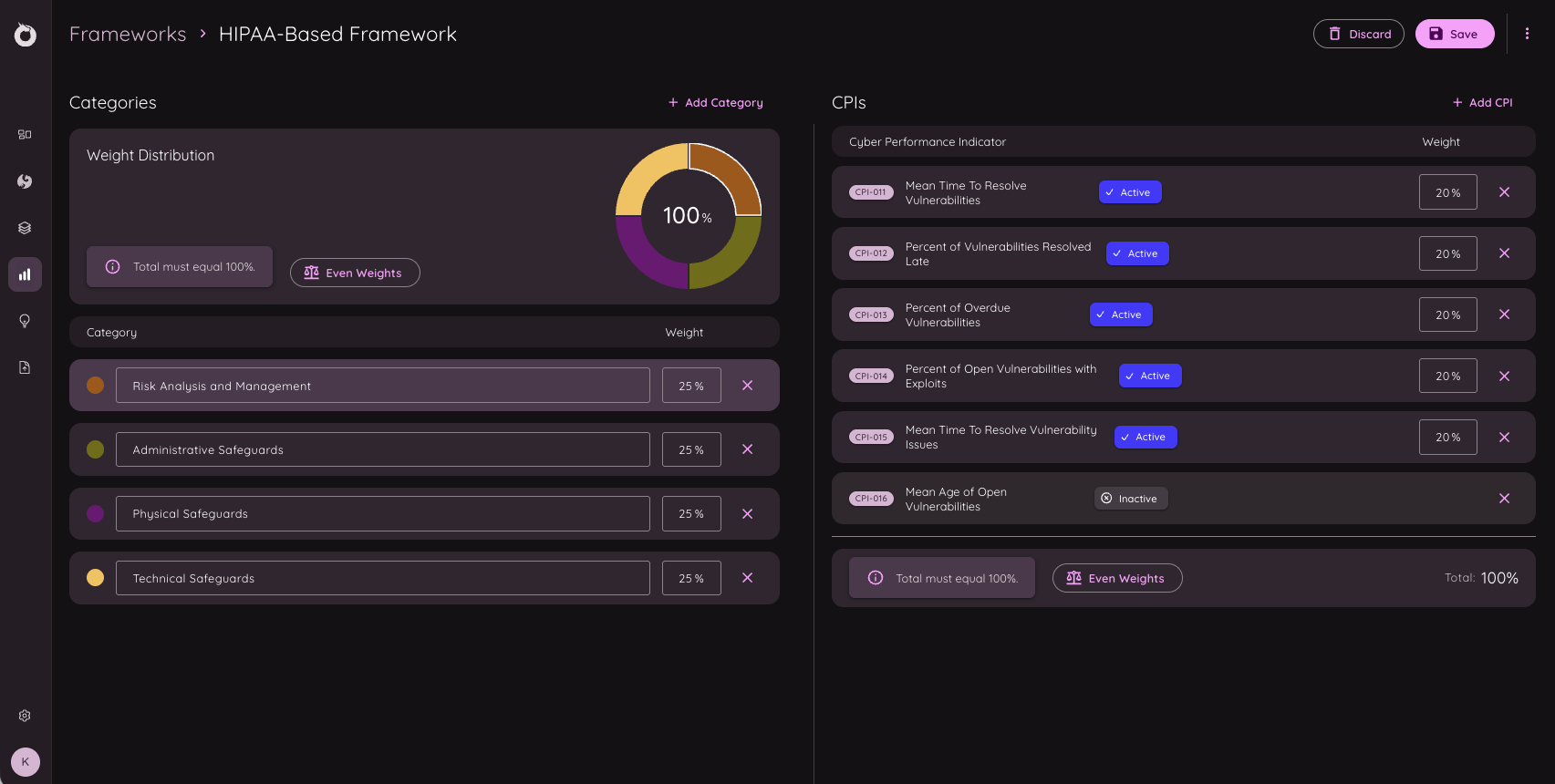
Instantly align your cybersecurity program to HIPAA with Onyxia's Custom Frameworks
2. Proactive Exposure Identification
With the new requirement for Asset Intelligence and Network Mapping, manual spreadsheets are a liability. Onyxia’s platform (and our AI agent, Nexa) proactively identifies program exposures. We map your security tools against your actual asset inventory to surface "blind spots" — the unmanaged devices or misconfigured systems where ePHI might be vulnerable.
3. Communicating Business Outcomes
One of the hardest parts of the new HIPAA rules is the increased documentation and reporting burden. Onyxia automates the translation of complex technical data into clear business outcomes. * For the Board: Demonstrate how your security investments directly reduce the likelihood of a $6M+ OCR fine. For the Regulators: Provide the "documented evidence" of security measures that OCR now explicitly demands.
Final Thoughts
For CISOs and security executives, HIPAA’s modernization is not a regulatory burden; it’s an opportunity to mature your security program. By aligning your controls with the new rule, you not only ensure compliance but also enhance resilience, improve vendor trust, and position your organization as a data‑protection leader in healthcare.
Is your security program ready for the August 2026 compliance deadline? Don't wait for an audit to find out. Book a demo with our team to ensure your program is resilient, compliant, and ready to deliver.